Richard Avedon
Richard Avedon was one of the greatest fashion photographers of the 20th century. Born in New York in 1923, Avedon began his photographic career in the late 1940s, quickly becoming one of the most sought-after photographers of his generation. His skill in fashion photography revolutionized the way images were presented and viewed by the public and fashion companies.
Biography
Richard Avedon was one of the most important photographers of the 20th century, best known for his portraits and fashion photographs. Born in New York on May 15, 1923, Avedon began exploring photography on his own at the age of 10, and quickly became passionate about portraiture.
In the 1940s he began working as a freelance photographer for various fashion magazines, including Harper's Bazaar, where he developed a unique style of fashion photography characterized by the use of movement and experimentation with colors and poses. In the 1950s he also worked for Vogue magazine, becoming one of the most important photographers in the world of fashion.
But Avedon was also a great portraitist, and photographed many celebrities including Marilyn Monroe, The Beatles, Andy Warhol and Tupac Shakur, to name just a few. In 1963 he took a famous portrait of James Baldwin, who became an icon of the civil rights movement.
Avedon continued to work until his death. He was one of the most influential photographers of the 20th century, and his work has been exhibited in major museums and galleries around the world. Furthermore, he has received numerous awards and recognitions for his career, including the Gold Medal from the National Arts Club and the Lifetime Achievement Award from the Council of Fashion Designers of America.
Although he passed away in 2004, his influence continues to be strong today.
Stile
His distinctive style is characterized by its immediacy, its essentiality and its intensity.

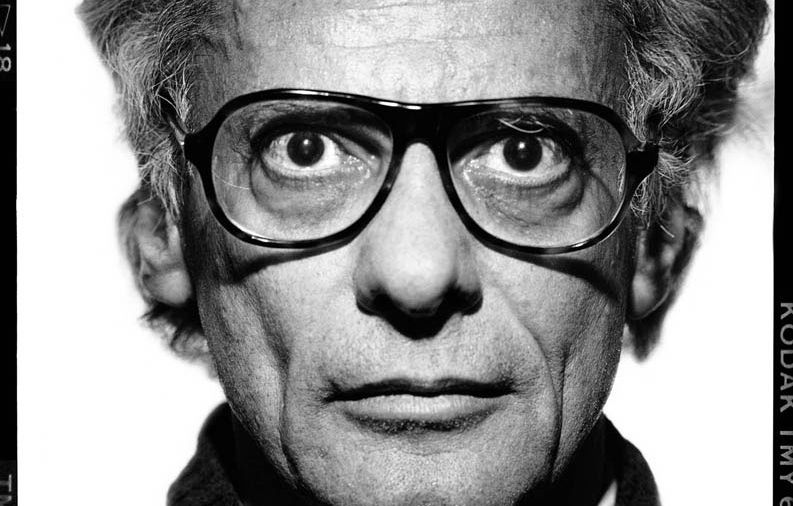
Avedon was a master of the art of portraiture, with an extraordinary talent for capturing the soul of his subjects through the lens of the camera. His portraits are famous for their simplicity, for their ability to focus on the subject and for their ability to show the essence of the person photographed. Avedon often used a white background to isolate the subject and make it stand out even more.
In addition to his portraits, Avedon was also an innovator in fashion photography, where he introduced a new style based on spontaneity and naturalness. His fashion photographs were different from those of other photographers, because Avedon tried to show clothing in motion, so that the public could get an idea of how they would behave wearing it.

But the most important element of Avedon's style is his attention to essentiality. Avedon always tried to show the truth in what he photographed, and that meant eliminating anything superfluous. His photographs are characterized by a very limited use of visual elements, which however are always carefully chosen to represent the subject in the most effective way possible.
Finally, Avedon's style is also characterized by his great sensitivity towards time. His portraits often show the wrinkles and imperfections of the subjects' faces, but in such a way as to make them an addition to their personality rather than a flaw. Avedon has always sought to capture the essence of the moment, letting imperfection add further depth and meaning to his photographs.
In summary, Richard Avedon's style is characterized by his attention to truth and sensitivity to subject and time. His work had a great impact on portrait and fashion photography, and is still a source of inspiration for many photographers around the world today.
Honoraries
During his life, Richard Avedon received many honors: we will now list and briefly describe the 7 main ones.
I. Gold Medal for Photography by the Royal Photographic Society: In 1985, Richard Avedon was awarded the Gold Medal for Photography by the Royal Photographic Society, one of the most prestigious awards in the world of photography.
II. International Center of Photography Infinity Award for Lifetime Achievement: In 1993, Avedon was awarded the International Center of Photography Infinity Award for Lifetime Achievement, an award recognizing a lifetime's work in the field of photography.
III. Gold Medal from the National Arts Club: In 1997, Avedon was awarded the Gold Medal from the National Arts Club, an organization dedicated to promoting art and culture in the United States.
IV. Oscar nomination for best documentary in 1994 with the film “Richard Avedon: Darkness and Light”: in 1994, Avedon was nominated for an Oscar for best documentary with the film “Richard Avedon: Darkness and Light”, which tells about his life and work as a photographer.
V. Honorary Member of the American Academy of Arts and Letters: In 1994, Avedon was named an honorary member of the American Academy of Arts and Letters, an organization dedicated to promoting the arts and culture in the United States.
YOU. Honorary Member of the Royal Photographic Society: In 1994, Avedon was made an honorary member of the Royal Photographic Society, an organization that promotes photography in the United Kingdom and around the world.
VII. Pulitzer Prize for Photography Nomination: In 1976, Avedon was nominated for the Pulitzer Prize for Photography for his work on George McGovern's presidential campaign.
Bibliography
Richard Avedon never wrote any book, however there are many authors who have spent time talking about this great master of photography and documenting his career and his most famous works. Here are some of the most interesting books:
- “Richard Avedon: Photographs 1946-2004” – This album brings together a vast selection of Avedon's works, ranging from fashion photography to portraits of celebrities and famous personalities.
- “Avedon Fashion 1944-2000” – This volume focuses on Avedon's fashion photography, showcasing some of his most famous shots for magazines such as Harper's Bazaar and Vogue.
- “In the American West” – This book documents the series of portraits Avedon made in the American West from 1979-1984. The portraits show ordinary people in simple poses and without makeup, capturing the essence of life in the region.
Website
The Richard Avedon Foundation is a non-profit organization dedicated to preserving and promoting the work of celebrated American photographer Richard Avedon.
The foundation was founded in 2004 after Avedon's death, and is dedicated to preserving his photographic archive, promoting exhibitions of his work and providing scholarships for emerging artists. The foundation's archive is open to the public by appointment for research and study purposes.
The foundation has collaborated with major museums such as the Metropolitan Museum of Art in New York to organize exhibitions of Avedon's work. In 2023, for example, the foundation sponsored an exhibition of Avedon's photographic murals at the Met.
The Richard Avedon Foundation also offers grants for emerging artists in the fields of photography, film and visual arts, to promote Avedon's legacy and support young talent.
In summary, the Richard Avedon Foundation is a non-profit organization dedicated to preserving and promoting the work of celebrated American photographer Richard Avedon.
Quotes
Speaking of Richard Avedon, it is not only his technique that makes him unique, but also his words: during his career he spoke about his photography and his style in order to also immortalize with his voice what his art represented for him. Let's see some quotes.
"If a day goes by where I haven't done something photography-related, it's like I've neglected something essential. It's like I've forgotten to wake up."
This quote from Avedon underlines the importance that photography had in his life. And it reminds us that to become a successful photographer, you must always be motivated and committed.
"All photographs are accurate. None of them are the truth."
This phrase has often been discussed in the photography world, but what does it really mean? Avedon argues that photographs are always accurate in representing what has been captured, but can never be the ultimate truth, as they are always a subjective representation.
“There is no true beauty without a little imperfection.”
Here Avedon reminds us that perfection isn't always what makes a photograph interesting. Imperfections can add depth and character, making the photo even more fascinating.
"A portrait is not a likeness. The moment an emotion or a fact is transformed into a photograph is no longer a fact but an opinion."
Photography is not only an exact reproduction of reality, but it can also be an emotional and subjective representation.
“I'm not looking for beauty, I'm looking for truth.”
The artist here underlines his search for authenticity and sincerity in photography. What matters is not only external beauty, but also the internal essence of people.
“Photography is a trap for reality.”
Photography can be deceptive, it only shows us an instant of reality, and not everything that happens around it.
“There is nothing boring about photography, just boring people who aren't interested in photography.”
Avedon affectionately invites us to discover the enthusiasm and passion that photography can bring. It's just a matter of finding the right point of view.
Video
In this video it is possible to observe some of his most famous and iconic works, capable of summarizing his talent and his art.