Walter Albini

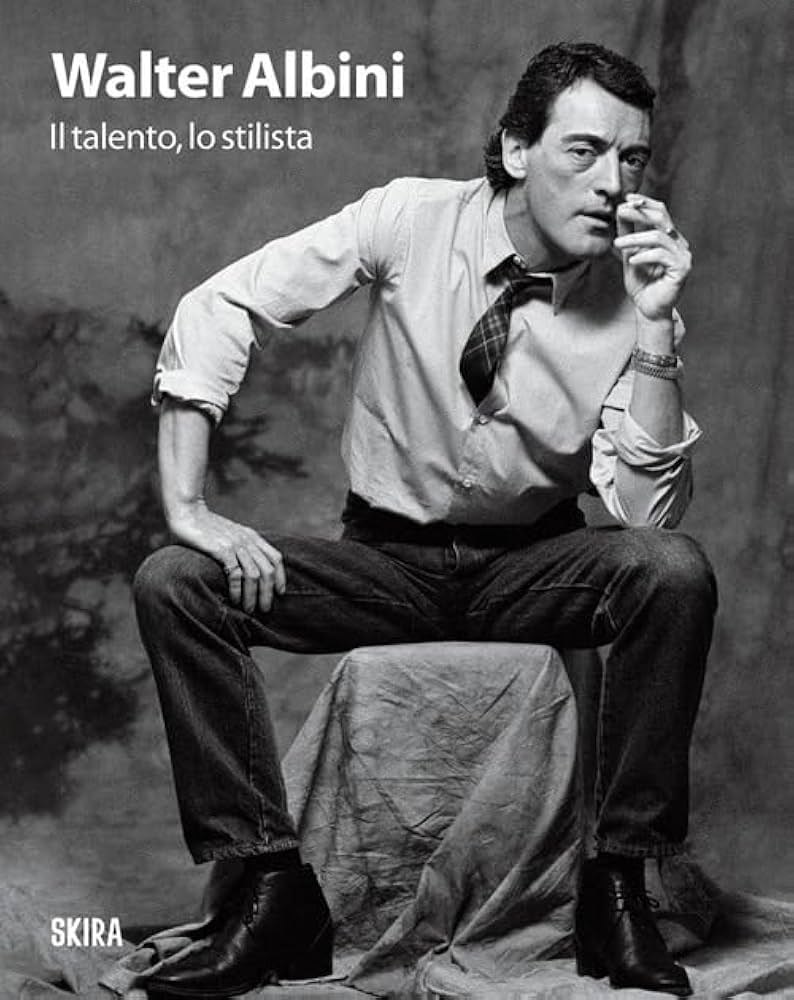
Walter Albini was one of the greatest Italian stylists, considered the pioneer of ready-to-wear and the total look. His vision revolutionized the relationship between fashion and industry, giving life to Made in Italy and the figure of the stylist as creator of style and image. 40 years after his death on 31 May 1983 due to AIDS, his legacy is still alive and a source of inspiration for many.
The biography of Walter Albini
Born Gualtiero Angelo Albini in Busto Arsizio on March 3, 1941, Walter Albini was passionate about fashion from a young age. He attended the Institute of Art, Design and Fashion in Turin, where he was the only boy in an all-female school. At 17 he began collaborating with newspapers and magazines, drawing sketches from high fashion shows, first from Rome and then from Paris. Here he meets Coco Chanel, his icon and muse.
His talent did not go unnoticed and he was soon hired by important Italian fashion houses, such as Krizia, Cadette and Trell. He also designs for international brands such as Cole of California. In 1970 he launched his first "unimax" proposal, a formula that provides uniformity of cut and color for men and women. In the same year he presented the Anagrafe collection, composed of eight long pink brides and eight short black widows.
The ready-to-wear revolution
Walter Albini is the first to understand the potential of ready-to-wear, that is, ready-to-wear, accessible and quality fashion. To realize his vision, he decides to collaborate with five fashion houses specialized in product types, coordinated according to a unified style project. This is how the total look was born, a concept that Albini also applies to his personal life, furnishing his homes and designing fabrics, objects, furniture and glass in tone with his collections.
Albini chose to present his creations in Milan and not in Florence, then the capital of Italian fashion. In this way it contributes to making Milan the new hub of international fashion. The foreign press defines him as the "new Italian star", comparing him to Yves Saint Laurent. The Italian press, on the other hand, appears colder and more critical towards him.
In 1973 Albini broke all contracts with fashion houses and presented a new line for men and women under his name in London. It is the first time that the formula of a first line with a strong image but limited sales, economically supported by a second line for diffusion, has been adopted. In the same year he opened the showroom in via Pietro Cossa in Milan and moved to Venice, where he organized a memorable fashion show at the Florian café.
High fashion and the Thirties
In 1975 Albini made his debut in high fashion with a collection inspired by Chanel and the Thirties, his lifelong loves. His style is characterized by the refinement of the lines, the refinement of the materials, the attention to detail. Albini loves to reinterpret the classics of the women's wardrobe, such as the deconstructed jacket, the trouser suit, the double-breasted coat. Her favorite colors are black, white, beige and powder pink.
Albini is also a great experimenter: he introduces new fabrics such as metallic jersey, lurex and vinyl; play with geometric, floral and animal prints; mixes oriental and European influences; is inspired by cinema, art and literature. Among his muses are the actresses Marlene Dietrich, Greta Garbo and Katharine Hepburn.
The legacy of Walter Albini
Walter Albini died prematurely in 1983, leaving a void in the world of Italian fashion. However, his work is recognized as fundamental for the development of Made in Italy and for the affirmation of the figure of the stylist as an author and entrepreneur. Many of his colleagues and successors were inspired by his vision and style.
Today his name is back in the limelight thanks to the news that the Walter Albini brand has been acquired by a Swiss group which intends to relaunch it on the market. Furthermore, an anthological exhibition dedicated to his career is being prepared and will be curated by Carla Sozzani. Walter Albini is therefore a hidden jewel of Italian fashion that deserves to be rediscovered and celebrated.